Thursday, December 13, 2012

Bingo bango

Jesus. Now there's a "Bing Desktop" app included in optional Windows updates!

Go away Bing. No one likes you. You are bong's way uncool little brother. Stop trying so hard.

You are one letter shy of a farmer's dog or a senior citizen's good time. That free space isn't free.

Share/Save/Bookmark

Wednesday, December 12, 2012

Stay on Target

I know I'm not the only one to have this experience.

In a moment of weakness I walked in to Walmart; it was right there, and I figured discount retailer equals discount retailer.

Did I ever learn my lesson ... again. It's been a while. But what an agglomeration of genetic abnormalities ...


... slouch through that beastly realm.

The Second Coming by William Butler Yeats
Turning and turning in the widening gyre
The falcon cannot hear the falconer
Things fall apart; the centre cannot hold;
Mere anarchy is loosed upon the world,
The blood-dimmed tide is loosed, and everywhere
The ceremony of innocence is drowned;
The best lack all conviction, while the worst
Are full of passionate intensity. 

Surely some revelation is at hand;
Surely the Second Coming is at hand.
The Second Coming! Hardly are those words out
When a vast image out of Spiritus Mundi
Troubles my sight: somewhere in sands of the desert
A shape with lion body and the head of a man,
A gaze blank and pitiless as the sun,
Is moving its slow thighs, while all about it
Reel shadows of the indignant desert birds.

The darkness drops again; but now I know
That twenty centuries of stony sleep
Were vexed to nightmare by a rocking cradle,
And what rough beast, its hour come round at last,
Slouches towards Bethlehem to be born?

I got more and more spooked as I meandered among the aisles; ultimately I put my few items back and walked right out, got in my car and drove to Target.


I'm definitely in the latter's target demographic (huh huh) I learned. Seems a small matter, but egads, gadzooks and great googly moogly. I'll take the illusion of differentiation over the bleak light of day experience of hob-nobbing with the hoi polloi.

"God must have loved the common man, for he made so many of them," Grandma R. used to say. Such haughty self regard cuts against the Midwestern lumpen proletariat ethos, but so does higher education, avant garde cultural insurrections and top shelf imported scotch.

I'll take my elitist snobbery hand in hand with a red and white shopping bag, thank you.

They have that popcorn machine right at the entrance anyway.


Share/Save/Bookmark

Sunday, October 21, 2012

Indians a-coming: Even the Beautiful Losers get lucky sometimes

A thrill to Catholic Indians, not so much to the still-irked trueheart heathens
Says Jezebel: "During an elaborate ceremony at the Vatican's Saint Peter's Square that involved a lot of fancy costumes, bejeweled bibles, Latin liturgies and probably some bored, sleep-weary children, clandestine Sith lord Pope Benedict XVI canonized Kateri Tekakwitha, making her the first Native American saint."
Catherine Tekakwitha, an ancient Mohawk Indian whose encounter with the European invasion led to grisly tragedy yet gave her "immortality," becomes an alluring metaphor at the heart of Beautiful Losers, the novel by Leonard Cohen, better known of course for his music. The book meant a great deal to me in my 20s, when I lived for a time at 25th Street and Florida Avenue in San Francisco and imposed the prose on as many friends as would borrow it.

A first edition from 1972 in Australia sure looks pretty cool
"Gorgeously written … one comes out of it having seen
terrible and beautiful visions" says the
New York Times of Cohen's book
In an astounding coincidence, there was a mural at the end of my block at 24th Street in the barrio neighborhood that featured classic American Indian and Mestizo imagery -- corn fields, pueblo pastel colors and proud brown faces looking stoically ahead. And one of the people beatified in the work, alongside Cesar Chavez and the like, was none other than Tekakwitha, shown in a deerskin tunic and with beads and feathers dangling from a badge in her straight black hair, her sharp features etching a picture of lasting beauty in my mind. Or so I envision it now.
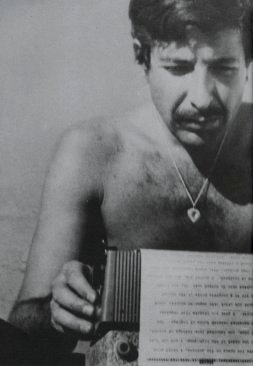
The Leonard Cohen Files shows him
getting it done back in the day
By contrast, as Cohen memorably writes, Tekakwitha "was not pretty," bearing the scars of some facial skin torment. For all this Chicago expat blogger knows, the grueling winters in Iroquois country that became upstate New York and Quebec helped to do her complexion in. Yet the iconic La Raza-style rendition of the Native lass was impossible not to fall in love with, in a fashion, just as the central character of the book falls in love with her culture-spanning story.

The book is considered an "experimental" work of the '60s, with its split narratives and time shifting and wordplay as I recall. Despite its genuine warmth and scathing honesty, it reads a bit sophomoric to me now. Cohen said he typed the whole thing on speed.

But as a seeker living at the edge of the world, looking for adventure or whatever comes our way, it felt like a heavenly blast of Truth and Art and Transcendence and all those restless romantic intellectual spiritual passionate Manichean-dichotomy-resolving, trauma-healing, angst-abating ideals that make a man do strange crazy things in pursuit of himself, of meaning, of happiness, of peace or enlightenment, pleasure or pain, whatever.

So often it all leads instead to chaos, doubt, angst, pitying -- and back to the beginning. I'd summon the image of a serpent eating its own tail at this point, but that seems a bohemian indulgence too far.

Christ. Writers. They try to get away with murder.

Tekakwitha recently became a saint in the Roman Catholic Church, or so I read. Much more important, she is used to stirring effect in Cohen's piercing novel. 

//SPOILER// I will never forget the brilliant, astonishing, koan-like insight at the philosophic "climax" -- the dramatic apex of a piece of prose, or so a schoolmarm taught me, to some use at least, in my formative years -- of the story, as I recall: "I change! I remain the same!" It still wells up feeling in me to think and write and read those words.

As an aside, eventually a gay couple bought the house I was living in and tossed us scrabbling renters out. One was a scab news photographer filling in for the AP during a strike; one was a barmaid from Montreal, Cohen's hometown; another was a girl I loved and lost who ascended to some kind of museum conservation expertise. 

Fog City offers a litany of noirish indulgences,
then as now
I think I was office temping or doing something like that when not becoming one with grunge or pining for literary inspiration in my room, lurking at arthouse cinemas or orbiting the city's phantom French Quarter for noir ambiances, mingling with the demimonde or engaging in other scurrilous and unseemly actitivies in the wild '90s. A friend at the time called my job "pretty Beat," which felt beyond redeeming to a would-be creative trapped in a tiring gray suit and tie workaday world. 

Yeah. That. My side point being, such are the downs and ups of "blight" and "gentrification" in a city, where perchance an Irish neighborhood might transubstantiate into a Latino one, enticing pioneering hipsters to move in, only to attract higher-class homeowners (huh huh) and reincarnate the 'hood as a respectablish locale. The humanity.

A fine feature review of the novel is here if you want to immerse your soft warm brain in a deeper vat of literary ponderingness.

And hey, here's a whole latterday Cohen concert if you're interested. His lyrics appeal to the Bukowski in me. Plus he wears a bad fedora.


On that note, here's that guy who sang of a Leonard Cohen afterworld and now resides On a Plane of his own. Why not.


// ENTREATY //
I am stymied, by the by, that I cannot find the mural shown online anywhere, despite no dearth of documentation on "Mission District murals." To wit

The painting in question is on a diocese building or something like that. Maybe the Church put a hex on those who would steal the soul of the souls so depicted? Perhaps someone in San Fran will elevate the mural to the digital plane. 

Once upon a time I took pics myself to slide inside the cover of the book, but those bygone media of the era have proved far less digitally shareable with their disappearing into boxes and such than what the kids do today with their fancy doowhacky devices with the thingamabobs and the ganeckdagazoinks and so on. Kids.

Share/Save/Bookmark

Monday, May 07, 2012

Trashique 2.0 fashion show benefit

It's painfully ironic. Fresno's grassroots artists too often exhibit collage works that look like they were assembled from junk in their parents' garages. It's, ah, a downscale scene generally.

But the Fresno Art Museum turned the notion on its head with the second Trashique fashion show, a benefit for museum programs that challenges local artists to concoct outfits using recycled material.

Some of the designers cheated on their content, which clearly did not all come from the city dump. Regardless, some snazzy styles emerged at the showcase, and I snapped a few pick-chas of the chicas on the runway, and beyond.

You might think it's a tongue-in-cheek concept, but the show is likely the biggest fashion extravaganza in Fresno all year, for models, designers and attendees. Which says a lot of things, but I'll let you make your own snide assertions.

More to come ...

 
This one I stole from Fresno State's The Collegian newspaper. What can I say, I led the set. I took a "placard" that said Media from the empty seating section for reports and stuck it on my shirt. Always the documentarian.
Share/Save/Bookmark

Monday, April 16, 2012

The man with the miniature orchestra

The latest Mad Men was the best yet. The show is unparalleled. I'm not even sure why it's so good; the characters are flawed at best, to reprehensible at worst. Peggy is the only one to really root for, and she's got her own issues (the nerve trying to balance a personal life and a career, that never works for women in Hollywoodland).

Mad Men's writing is so snappy, and the people are portrayed so perfectly. Pete is really the secret weapon; I'm reminded of the "evil surgeon" on ER who eventually took a beating (and then some) for his "tell it like it is" big mouth. Sometimes the best actor -- or at least the sharpest character -- is the villain.


Things are gelling all around, and of course the "knowing winks" that travel through time (like that recent crack about Romney, actually Mitt's father in the mid-'60s) to give us something to smirk about are enlivening. The baby juggling earlier in the season, making Pete and Peggy squirm so cruelly, was genius.

But I think like everyone, I'm still looking for more Don, specifically more of this unfortunate youth he spent growing up in a whorehouse and, more important to the show's arc, the transformation of this country bumpkin into man of the world and master of the universe. Did he read the encyclopedia while he was selling furs? Take some business classes at least? There was no google button to learn everything from back then. Ultimately, how did he get so educated, effective (if he really is) and cocky?


"You told me your mother died in childbirth. Mine did too. She was a prostitute. I don’t know what my father paid her but when she died they brought me to him and his wife. And when I was ten years old he died. He was a drunk who got kicked in the face by a horse she buried him and took up with some other man I was raised by those two sorry people." (Don Draper, to Rachel Menken)
It's pretty hard to will yourself to the top. That kind of "inner game" doesn't come like flicking on a light. It's more like the sun gradually rising, and it cycles to some extent as your confidence ebbs and flows through life, unless you find a way to artificially hold it up. Mercurial Don makes being the kind of guy who walks in like he owns the place look as easy as glib Roger does wining and dining clients and acting charming in spite of himself, although we know they're both unhappy and faking it.

The brief discourse on being gay was notable. Pete's bluntness talking to Lane ("... he thinks you're a homo"), contrasted with the madame's supposed smooth operating with Don, marked an obvious character divide: Lane knows he's effete-acting and probably has been needled as a queer plenty; Don's knowledge that he's anything but -- of course ;) -- gives him supreme confidence to dismiss such a misguided appellation.

Anyway it's amazing fun to watch the lot of their stories unspool. Here's hoping the brimming subtext finds eventual dramatic explication. The man with the miniature orchestra ... what a clever way to wrap things.

Culture critic mode, disengage.


Share/Save/Bookmark
P.S. Much as I enjoyed this latest episode, the previous one -- I wound up watching them out of order -- where a tipsy Peggy bantered with Roger was equally genius. She seems to get some of the most prickly dramedy-type moments in the show. Clever indeed how she's the one wearing the pants, despite literally kicking up her heels in a skirt, as he begs her to do her job in a rush to cover his own ass, and she fleeces the rube. Despite the creepy sex-murder-mayhem undertone via Chicago, it was a joy to watch the character's fine bristle brush strokes.

Holistic wellness center coming to Fresno


An innovative way to address mental health challenges is coming to salt of the earth Fresno, California -- a holistic wellness center. Here's a sample of my latest article for HealthyCal.org, a nonprofit, public policy reporting website.
It's all about balance

Holistic mental wellness center coming to Fresno


By Todd R. Brown, California Health Report

To some immigrants, the details of Western medicine lie in unfamiliar territory, so certain maladies wind up being treated by traditional healers rather than modern medical practitioners.

To remedy that dichotomy between the old world and the new, Fresno County plans to open a holistic wellness center that will link Hmong, Latinos and other groups with spiritually fulfilling as well as evidence-based solutions to mental health worries.

Staffing will be contracted out, and three groups responded to the county’s request for proposals. One of them, the Fresno Center of New Americans, is a nonprofit that formed in the early ’90s to help Cambodian, Lao and Vietnamese refugees adjust to life in America. Over time it has expanded to aid other immigrant groups as well as low-income residents.

One challenge with such clients is that stoic immigrants and proud blue collar workers tend to stigmatize mental health trouble as a weakness. And in some traditional cultures, including in Central America and Southeast Asia, stress may not be seen as a culprit in emotional distress.

“Hmong believe that the body is inhabited with many souls and spirits,” said psychologist Ghia Xiong with the Fresno Center for New Americans, discussing the non-Western model of mental health. “The whole goal for the body to be in good health is to have these souls in balance.”

In this world view, a traumatic incident can cause a person’s spirit to depart his body, Xiong said. The resulting imbalance, which a Westerner might diagnose as depression or neurosis, is perceived by a tradition-minded Hmong as requiring shamanic intervention.

“They may see a doctor and say, ‘I don’t feel too well, I’m feeling very irritable, and I’m having headaches,’ and the doctor gives medicine for pain,” Xiong said. “Then they might want to see a psychiatrist and talk about how they feel, what they think. But that doesn’t really solve the third issue of their spiritual health, the third component.

---

Enjoy the full article on Healthycal.org.


Share/Save/Bookmark

Monday, March 26, 2012

When I left you I was but the learner

Like many of my fellow alumni, I was disappointed to learn that Rick Santorum was making a campaign stop at my high school. Even worse than giving that Christian sharia law advocate a recognized platform, though, was how school teachers and administrators meddled with the students being able to share their concerns directly with the candidate.

While some students got to ask Santorum some "tough questions" -- just barely -- others felt that Santorum tried to dodge real answers. School officials admitted filtering out certain questions from the ones that students submitted to ask. Per the Daily Herald:
Questions were screened by both school officials and Santorum’s advisers, said English department head Charles Venegoni. Ones that asked about social issues such as gay rights or religion were rejected.
Below is my letter written to a local newspaper criticizing the excessive oversight. I may have connived to get their attention with some fulsome notes up top. Gotta know your audience ;)

My sly reference to Nirvana's Serve the Servants ("self-appointed judges judge / more than they have sold") is intact, something I imagined in my ancient wisdom "the kids" would appreciate. Hi kids! My reference to my high school era 'zine, Another Point of View -- which no one but a tiny handful of friends would have noticed -- is also there.

APoV may or may not have been printed on photocopy paper liberated from Hersey storeroom shelves, by the way. Which reminds me, when a controversial letter I wrote as a student to the school newspaper, The Correspondent, was published before administrators could intervene, I briefly earned the nickname The Hersey Anarchist.

Some things never change. Here's my latest letter (headlined by the newspaper):

Hersey Sets Bad Example At Candidate Event


Editor, Journal: Thanks for reporting on Rick Santorum’s visit to Hersey High School in Arlington Hts. with some critical insight and greater detail than I found in other local newspapers’ coverage.

The notion that a school would filter questions from students to a political candidate sends a pathetic message to young people. In a land where free speech is a unique founding principle, to communicate to children that their thoughts and words must be moderated by self-appointed judges, undercuts the “inalienable” rights that Americans have always been taught make us who we are.

I applaud you for speaking with Santorum’s opponents outside the event and for indicating that not all citizens, in Chicago’s suburbs as elsewhere, are content to watch the nation’s most essential principles of liberty be trampled ignorant social overseers.

As a graduate of Hersey High and a professional journalist -- the same trade that my school’s namesake, John Hersey, plied -- I am disappointed that my alma mater chose to muddle its mission of teaching students how to think critically and participate in the greater society that the school is a microcosm of.

A lot has changed at Hersey in the past couple decades. The ideas that bullied students are now told “it gets better” and that openly gay youths be unafraid to reveal who they are, is lightyears from the turn-the-other-way attitude that I and many other students endured for many uncomfortable years at Hersey. Yet the school itself seems to be bullying its students in a more insidious way: by kowtowing to a dubious guest whose visit was supposedly to cast light on his beliefs, effectively silencing another point of view.

To coddle a candidate instead of putting him to the true test of answering to his fellow citizens directly is a foolhardy and cowardly capitulation to social modesty and philosophic meekness. Hersey administrators and faculty should be asking themselves if they fell short of a liberal arts education’s mission: to foster intellectual enlightenment and build character, not facilitate status quo complacency and image conscious hypocrisy.

Todd R. Brown, Hersey Class of '88

* * * 

And wouldn't you know. The day after Santorum's visit, a spate of homophobic graffiti occurred around Arlington Heights, Ill., where the school is. Sometimes people wonder if I'm gay since I identify with their rights struggle. Typically my silent answer to the unasked question is none of your business. But basically, I abhor bigotry, and these days as a former underdog, I fight the power for the people.

By the way, who woulda thunk, there's another John Hersey out there. And one more trivia note: Hollywood came to town and shot some of the new A Nightmare on Elm Street at Hersey. Talk about a nightmare ... "you're in high school again."


Share/Save/Bookmark

Thursday, March 22, 2012

Flashback: The Black Panther Party, then and now

In light of the tragic Trayvon Martin killing in Florida, I think this article I wrote on Black Panthers' cofounder Bobby Seale a few years back is worth a rerun. Empowerment to the people ...

Panthers' Seale: 'It was about a principle,' not being 'macho'

Group's co-founder, now 70, joins panel discussion at Ohlone College


By Todd R. Brown, Staff Writer.

Thursday, May 10, 2007—Reprinted from The Argus.

Bobby Seale.Bobby Seale, co-founder of Oakland's Black Panthers, discusses the social struggle of the '60s on Wednesday at Ohlone College. (Anda Chu - Staff).
FREMONT—Forty years ago, a group of armed Black Panthers entered the state Assembly chamber to protest a gun control bill that Panther founder Bobby Seale said would keep blacks "disarmed and helpless."

It was a shocking move for the upstart activists, clearly signaling that the militant civil rights campaign of Malcolm X would not die with its recently murdered leader.

The Panthers inspired leagues of other rebels, including the White Panthers in Michigan and senior advocates dubbed Gray Panthers. The Black Panthers weren't posturing for posterity when they confronted their enemies in the establishment, Seale said. They were on a mission.

"It was organized. It was disciplined. We knew our history. It wasn't macho, it was about a principle," said Seale, who ignited the group with Huey Newton in 1966 in Oakland. "Power to the people."

Seale appeared Wednesday at Ohlone College for a panel discussion titled "Pioneers of the Civil Rights Era," moderated by Chicano studies professor Mark Salinas.

The half-dozen veterans of the Age of Aquarius told a packed house what it meant to them to take part in a collective grass-roots movement.

"We just thought we were going to change the world right away," said Maria Ramirez, an 
Ohlone counselor and founding member of the Chicano Student Union at Chabot College in Hayward.

As time went on, she said, the members of the1960s generation realized, or perhaps rationalized, they were part of a larger continuum.

"We're part of 500 years of resistance," she told the diverse students gathered in the Jackson Theatre. "You are living history."

Los Angeles Times columnist George Skelton, who recounted the Panthers' 1967 confrontation in Sacramento in a May 3 article, noted that "the Panthers looked scary, but really weren't."

Certainly Seale cuts a more genteel image at 70 than he does in black-and-white photos showing a leather-jacketed, beret-clad, pistol-packing firebrand.

On Wednesday, he wore a Berkeley YMCA cap, a tan button-down shirt, and khakis supported by suspenders and a belt, and carried a mirthful look on his face.

The Texas native, whose family moved to the West at the end of World War II, shared his own activist awakening in 1962 when he worked as an engineer on the Gemini missile program in San Leandro and took classes at Merritt College in Oakland.

He checked out a street rally where a preacher described visions of the kings of western Africa, a revelation for Seale.

"Here I am getting A's in mathematics, and I didn't know nothing about this history," he said, noting that he picked up little about black history at Berkeley High School, except that "slaves sat on a stoop and played the banjo."

Another seminal influence was the Rev. Martin Luther King Jr.'s proposed boycott of companies that would not hire blacks, including bread companies.

"We want Wonder Bread to wonder where the money went," Seale recalled King saying.

A trio of Logan High School students who sat in the first row of the 400-capacity room seemed particularly receptive to Seale's wisdom.

"This is a pivotal point in my life," said David Collins, 17, a junior at the Union City school. "I get to see a glimpse of the magnificence that was once the Black Panthers."

Abel Shifferaw, 16, another junior, said he had read extensively about the Panthers, whom the FBI accused of being communist for hosting a free breakfast program for Oakland schoolchildren. Shifferaw was even inspired to help found a socialist group at Logan, the People's Vanguard Party for Social Defense.

"My mom doesn't like it too much," he said, wearing a goatee, a slight Afro and thick-framed glasses a la Malcolm X. "She's from Ethiopia. She'd rather I'd become a doctor or something."

Seale's wife, Leslie Johnson-Seale, 58—they met when she joined the Panthers in 1969—manned a table outside the theater with DVDs and books for sale such as "The Black Panther Party (Reconsidered)."

She said the couple had been living mostly in Philadelphia, where she is from, for the past 25 years or so, but started staying part of the year in Oakland at Seale's family home around 2000.

Today, she said, Seale works with the Eastside Arts Alliance in Oakland, which provides an artistic outlet for at-risk youths, and Urban Releaf, an East Bay tree-planting group.

She said she has few regrets from her Panther days, when she lived communally with other young people who felt driven to change the world.

"When it was over, it kind of left us confused," she said. "Because it was a way of life."
Seale said he wouldn't change his past, although he lamented the violent end for some of his fellow Panthers, such as Fred Hampton, whom police in Chicago shot dead in 1969.

"I wish I could change the situation for some of my friends who were killed," he said.

Reflecting on the social progress so many of his generation, of all colors, fought for, Seale concluded: "First of all, you're human. You're part of the greater humanity of the whole Earth—your thinking, human mind."


An entertaining dramatization of the Black Panthers' story is 1995's Panther by Mario and Melvin Van Peebles.
Share/Save/Bookmark 

Friday, March 16, 2012

Microfarming takes tenuous hold in the Central Valley

My article on Central Valley small-scale farming versus industrial agriculture is up on HealthyCal.org, a nonprofit, public policy reporting website. Here's an excerpt; I also shot photos for the piece, which are running in March at the top of the main site.

--------

Despite increasing demand, small farms face disadvantage
By Todd R. Brown

Rancher Maria Abuelas of Madera County talks grass-fed beef with
a shopper at a Fresno farmers market. Photo by Todd R. Brown.
Maria Abuelas is off to a modest start as a rancher in the Sierra foothills, where she keeps a herd of about 20 grass-fed cattle on 200 acres.

“That’s my passion these days,” she said with a gleam in her eye, “growing good grass.” For ranchers in her field, alfalfa is their herd’s prime indulgence.

For generations, most American meat eaters have supped on grain-fed beef, which some of today’s connoisseurs say lacks taste and nutrition compared with the grass-fed variety.

Consumers are more and more concerned with such food production matters as supporting sustainable farming, buying from local growers and avoiding genetically modified fare. That trend encourages small-scale producers like Abuelas, who are connecting with customers alarmed by bioengineered foods making their way to the table and who pine for a more time-honored approach to their sustenance.

Yet for the most part, food distribution remains dominated by quantity-driven corporations, and some small farmers in the Central Valley struggle with a food system controlled by a few distributors and dominated by larger-scale producers who are jumping on the green bandwagon for a piece of the $30 billion industry.

---------
Read the full story on HealthyCal.org. They do good work, including recent stories on child abduction relating to the Steven Stayner tragedy and nuclear power in California.

Share/Save/Bookmark

Tuesday, February 21, 2012

What is New Orleans, on a Mardi Gras day ...

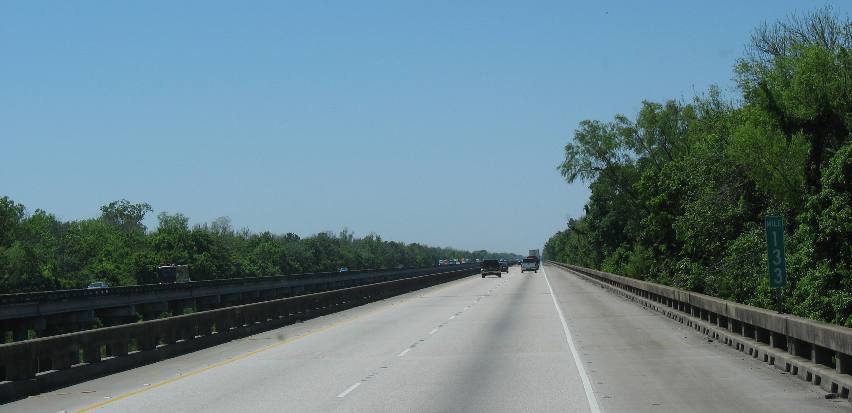
The po' boy sandwich. A true time-tested New Orleans institution. Take your french bread, spread some mayo on, drop some lettuce and tomato on top, coat liberally with fried shrimp and oysters, or "barbecue" shrimp, or roast beef and gravy, or whatnot and so forth. Blam. That's good eating. I remember one heartbreaking day I was off out of New Orleans, after a few months' stay, and headed west. Before I went I got the aforementioned 12-inch half shrimp, half oyster po boy from the St. Roch Fish Market (defunct after Katrina) and ate it in the car on I-10 straight out of my lap. A little taste of ambrosia on a humid Sunday morning ...

The Atchafalaya Basin Bridge on I-10 in Louisiana
The best po' boy "restaurants" aren't famous names like Parkway Tavern or Domilise's. They're off the map, out of the way, down in the backwater-type shacks and fast-food-looking joints and sketchy corner grocery stores with bullet-proof glass and steel-grate doors in neighborhoods you don't wander in at night. (I found it quirky that, while some were black owned and operated, others were run by Asians, Vietnamese among others. I imagined that owner A sold the place to owner B on condition of handing down the secret recipe to the ancient family's original cooking.)

My faves were always at the Marigny's edge or in the Bywater neighborhood, in the (Upper) Ninth Ward. Some like Captain Sal's are on relative thoroughfares like St. Claude Avenue. Others are peppered along residential streets, a seductive scent wafting in the jasmine-tinged air, made with that magic recipe containing something invisibly delicious you just don't get at the clearinghouse tourist places -- or even the workaday spots where regulars flow in and out for lunch.
Vaughan's Lounge at a corner of Dauphine and Lesseps streets in Bywater
I'll fight you on this. I'll take my french bread loaf and bop you on the head.

I'll take my late-night two-bit emergency ration po' boy from the store next door to the all-night daquiri shop with the police siren flashing blue light spinning around and around, the under $5 joint where maybe I'm the only white customer after midnight and the dingy walls are streaked with grease and the general mood feels heavy with hard-knock weariness in a decaying, decadent city on the river at the edge of the continent in a world all its own. And I'll take a bite. And I'll take another bite. A scrumptious special bite. And I'll give you a look that says, don't you mess with this. This is my little pleasure. This is my kind of comfort.

This is a moment in a lost, low-down world where I feel almost home.

Share/Save/Bookmark

Wednesday, February 15, 2012

Better to burn out than to fade away?

All this unending praise of Whitney Houston. You'd think she did something relevant for the past couple decades besides give a public show to her slow self-destruction. It's sad, but the story should be cautionary, not laudatory. She had some singing talent, fine. But what about songwriting? What about distinguishing herself from the R&B pack of her day, Paula Abdul, Janet Jackson, blah blah. You could throw Pebbles in there for all their lasting worth. People were surprised to see Kurt Cobain's photo on the cover of the New York Times when he died. He was a "generational spokesmodel," a whiny "grunge poet" who had more in common with Beavis and Butthead than Bowie, a Lennon wannabe who abandoned his kid (hmm).


Yet he was at the top of his game when he went out. He changed what people thought pop music could be and led a cadre of underappreciated alt-rockers, past and future, through the open door behind him, blowing fresh artistic wind through. He was still a star and still resonant to millions of misbegotten kids no matter how ironic he felt as a punk icon while so many deserving kindred spirits toiled in obscurity. He rebelled against a status quo that many thought could not be toppled, an unstoppable force that actually moved the immovable object. He played a song called "Rape Me" on Saturday Night Live. He knocked Michael Jackson off the No. 1 spot for record sales, back when records were purchased. Sure, he copped out, but he did it in his own overheated, historic, raging fashion. Kurt burned out; Whitney faded away.

It takes real courage to reveal your hurt, your heart. It might seem simple to rage on stage, to strum grungy power chords and murmur and scream. But it takes real work to hone a talent for songcraft, perfect pitch and artisanal indie rock taste, and put that out there amid a sea of also-rans and depressing discouragement that you'll pierce through the punk-by-numbers fray and be heard. It takes balls to walk into a record company office and sign a contract, knowing your "friends" will turn their back and call you a sellout, even when you really compromised nothing.


Bettie Serveert sang "What Friends?" They also sang "Bow down a band's been discoverd ... Everybody loves a band that sells." Notably they also sang "Smack in the middle of ridiculous places" ...


Whitney surely had her own demons to contend with, but her music revealed none of her genuine self, her challenges she'd overcome or that were still weighing on her. She sparkled like jewelry for a short while, then trickled quickly away as the next American idol took the stage. Kurt streaked across the sky like a meteor shower, then went dark. Did either make the most of life? Of course not. Kurt never saw this side of 27, for heaven's sake. But whose art touches the soul with more genuine feeling and genius style? Who shared their true emotion?


I sympathize with Kurt's psychic suffering and his anger at the world, absolutely. A lot of people bury that angst inside and effect catharsis where they won't make a spectacle of themselves. Some use it as the drive behind their artistry and share their agony with the world; that may help people feel less alone in their alienation and be a step toward getting real help, being able to cope with perpetually grey skies even when the sun shines bright around them. "The bitterness of one who's left alone" ...


Kurt's story also is a tragic one, and especially cautionary in a scene where self-medicating is a time-honored ritual and easy initial escape that descends to addiction. Too many died too early in Seattle music. And the words and sounds echo with self-destructive angst.

Soundgarden sang "Like Suicide."


Screaming Trees titled an album "Uncle Anesthesia."

Alice In Chains wrote the defiant "Junkhead."

Pearl Jam still sings of being "In Hiding," "In My Tree," feeling "Black" and not living in the "Present Tense."


Life seems depressing up there! And surely Kurt needed more than catharsis. Maybe Eddie Vedder talks to a shrink about his youthful ennui and outsider status. Kurt certainly kept part of himself hidden, a survival tactic before and after his fame. His lyrics are oblique, hinting at pain and numbing strategies but barely revealing the bullying and parental estrangement that ate at him, whereas Vedder's by contrast are direct regarding social alienation and introspective coping. Kurt's spiritual torment, however, shot through in his music.

Kurt probably did need lithium. Those moments of "I think I'm dumb, maybe just happy" were too few ups to match the dragging, crushing downs. And Whitney needed "no men" around her rather than yes men. She needed a feeling of place, of family, of comfort beyond the needle or the powder.


"I miss the comfort in being sad," Kurt sang. That melancholy (or Mellon Collie) ache gives an ironic, peculiar comfort, but that feeling inside is unsustainable. The alternative, to be numb (as in the Sex Pistols' "No Feelings," a tune that is full of feeling really) is a sad state too. Billy Corgan sang "I'm all by myself" even surrounded by friends and family and a dysfunctional but productive band. We all need peace love and understanding, and whether we find it, some of us will always relate to that raw, searing agony of a less happy life.

Distortion makes us feel up, in a world of distorted priorities, and sarcasm ("cut you like you want me to") makes us feel real in a life of personae and pretend (L7's "Pretend that We're Dead" comes to mind).


Hey hey, my my, rock and roll will never die. Is this the story of the Johnny Rottens? At least "here we are now" still applies to all of us right now. That we can all agree is a beautiful, beautiful thing.


For more on Kurt's tragedy and beatification, I suggest Charles Aaron's eulogy.

Share/Save/Bookmark