Friday, March 16, 2012

Microfarming takes tenuous hold in the Central Valley

My article on Central Valley small-scale farming versus industrial agriculture is up on HealthyCal.org, a nonprofit, public policy reporting website. Here's an excerpt; I also shot photos for the piece, which are running in March at the top of the main site.

--------

Despite increasing demand, small farms face disadvantage
By Todd R. Brown

Rancher Maria Abuelas of Madera County talks grass-fed beef with
a shopper at a Fresno farmers market. Photo by Todd R. Brown.
Maria Abuelas is off to a modest start as a rancher in the Sierra foothills, where she keeps a herd of about 20 grass-fed cattle on 200 acres.

“That’s my passion these days,” she said with a gleam in her eye, “growing good grass.” For ranchers in her field, alfalfa is their herd’s prime indulgence.

For generations, most American meat eaters have supped on grain-fed beef, which some of today’s connoisseurs say lacks taste and nutrition compared with the grass-fed variety.

Consumers are more and more concerned with such food production matters as supporting sustainable farming, buying from local growers and avoiding genetically modified fare. That trend encourages small-scale producers like Abuelas, who are connecting with customers alarmed by bioengineered foods making their way to the table and who pine for a more time-honored approach to their sustenance.

Yet for the most part, food distribution remains dominated by quantity-driven corporations, and some small farmers in the Central Valley struggle with a food system controlled by a few distributors and dominated by larger-scale producers who are jumping on the green bandwagon for a piece of the $30 billion industry.

---------
Read the full story on HealthyCal.org. They do good work, including recent stories on child abduction relating to the Steven Stayner tragedy and nuclear power in California.

Share/Save/Bookmark

Tuesday, February 21, 2012

What is New Orleans, on a Mardi Gras day ...

The po' boy sandwich. A true time-tested New Orleans institution. Take your french bread, spread some mayo on, drop some lettuce and tomato on top, coat liberally with fried shrimp and oysters, or "barbecue" shrimp, or roast beef and gravy, or whatnot and so forth. Blam. That's good eating. I remember one heartbreaking day I was off out of New Orleans, after a few months' stay, and headed west. Before I went I got the aforementioned 12-inch half shrimp, half oyster po boy from the St. Roch Fish Market (defunct after Katrina) and ate it in the car on I-10 straight out of my lap. A little taste of ambrosia on a humid Sunday morning ...

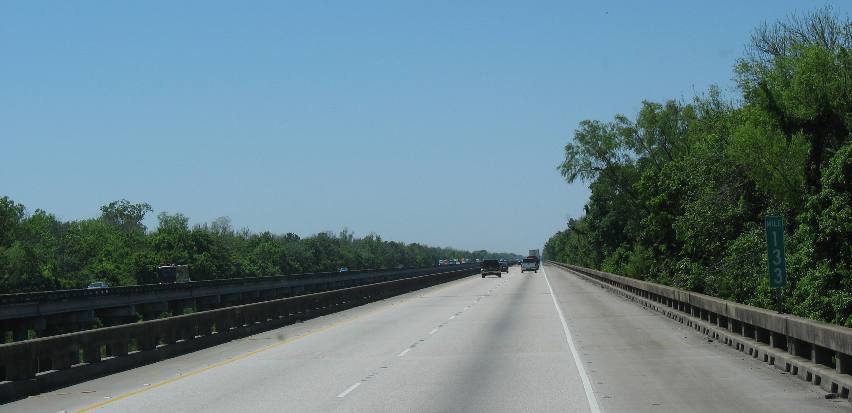
The Atchafalaya Basin Bridge on I-10 in Louisiana
The best po' boy "restaurants" aren't famous names like Parkway Tavern or Domilise's. They're off the map, out of the way, down in the backwater-type shacks and fast-food-looking joints and sketchy corner grocery stores with bullet-proof glass and steel-grate doors in neighborhoods you don't wander in at night. (I found it quirky that, while some were black owned and operated, others were run by Asians, Vietnamese among others. I imagined that owner A sold the place to owner B on condition of handing down the secret recipe to the ancient family's original cooking.)

My faves were always at the Marigny's edge or in the Bywater neighborhood, in the (Upper) Ninth Ward. Some like Captain Sal's are on relative thoroughfares like St. Claude Avenue. Others are peppered along residential streets, a seductive scent wafting in the jasmine-tinged air, made with that magic recipe containing something invisibly delicious you just don't get at the clearinghouse tourist places -- or even the workaday spots where regulars flow in and out for lunch.
Vaughan's Lounge at a corner of Dauphine and Lesseps streets in Bywater
I'll fight you on this. I'll take my french bread loaf and bop you on the head.

I'll take my late-night two-bit emergency ration po' boy from the store next door to the all-night daquiri shop with the police siren flashing blue light spinning around and around, the under $5 joint where maybe I'm the only white customer after midnight and the dingy walls are streaked with grease and the general mood feels heavy with hard-knock weariness in a decaying, decadent city on the river at the edge of the continent in a world all its own. And I'll take a bite. And I'll take another bite. A scrumptious special bite. And I'll give you a look that says, don't you mess with this. This is my little pleasure. This is my kind of comfort.

This is a moment in a lost, low-down world where I feel almost home.

Share/Save/Bookmark

Wednesday, February 15, 2012

Better to burn out than to fade away?

All this unending praise of Whitney Houston. You'd think she did something relevant for the past couple decades besides give a public show to her slow self-destruction. It's sad, but the story should be cautionary, not laudatory. She had some singing talent, fine. But what about songwriting? What about distinguishing herself from the R&B pack of her day, Paula Abdul, Janet Jackson, blah blah. You could throw Pebbles in there for all their lasting worth. People were surprised to see Kurt Cobain's photo on the cover of the New York Times when he died. He was a "generational spokesmodel," a whiny "grunge poet" who had more in common with Beavis and Butthead than Bowie, a Lennon wannabe who abandoned his kid (hmm).


Yet he was at the top of his game when he went out. He changed what people thought pop music could be and led a cadre of underappreciated alt-rockers, past and future, through the open door behind him, blowing fresh artistic wind through. He was still a star and still resonant to millions of misbegotten kids no matter how ironic he felt as a punk icon while so many deserving kindred spirits toiled in obscurity. He rebelled against a status quo that many thought could not be toppled, an unstoppable force that actually moved the immovable object. He played a song called "Rape Me" on Saturday Night Live. He knocked Michael Jackson off the No. 1 spot for record sales, back when records were purchased. Sure, he copped out, but he did it in his own overheated, historic, raging fashion. Kurt burned out; Whitney faded away.

It takes real courage to reveal your hurt, your heart. It might seem simple to rage on stage, to strum grungy power chords and murmur and scream. But it takes real work to hone a talent for songcraft, perfect pitch and artisanal indie rock taste, and put that out there amid a sea of also-rans and depressing discouragement that you'll pierce through the punk-by-numbers fray and be heard. It takes balls to walk into a record company office and sign a contract, knowing your "friends" will turn their back and call you a sellout, even when you really compromised nothing.


Bettie Serveert sang "What Friends?" They also sang "Bow down a band's been discoverd ... Everybody loves a band that sells." Notably they also sang "Smack in the middle of ridiculous places" ...


Whitney surely had her own demons to contend with, but her music revealed none of her genuine self, her challenges she'd overcome or that were still weighing on her. She sparkled like jewelry for a short while, then trickled quickly away as the next American idol took the stage. Kurt streaked across the sky like a meteor shower, then went dark. Did either make the most of life? Of course not. Kurt never saw this side of 27, for heaven's sake. But whose art touches the soul with more genuine feeling and genius style? Who shared their true emotion?


I sympathize with Kurt's psychic suffering and his anger at the world, absolutely. A lot of people bury that angst inside and effect catharsis where they won't make a spectacle of themselves. Some use it as the drive behind their artistry and share their agony with the world; that may help people feel less alone in their alienation and be a step toward getting real help, being able to cope with perpetually grey skies even when the sun shines bright around them. "The bitterness of one who's left alone" ...


Kurt's story also is a tragic one, and especially cautionary in a scene where self-medicating is a time-honored ritual and easy initial escape that descends to addiction. Too many died too early in Seattle music. And the words and sounds echo with self-destructive angst.

Soundgarden sang "Like Suicide."


Screaming Trees titled an album "Uncle Anesthesia."

Alice In Chains wrote the defiant "Junkhead."

Pearl Jam still sings of being "In Hiding," "In My Tree," feeling "Black" and not living in the "Present Tense."


Life seems depressing up there! And surely Kurt needed more than catharsis. Maybe Eddie Vedder talks to a shrink about his youthful ennui and outsider status. Kurt certainly kept part of himself hidden, a survival tactic before and after his fame. His lyrics are oblique, hinting at pain and numbing strategies but barely revealing the bullying and parental estrangement that ate at him, whereas Vedder's by contrast are direct regarding social alienation and introspective coping. Kurt's spiritual torment, however, shot through in his music.

Kurt probably did need lithium. Those moments of "I think I'm dumb, maybe just happy" were too few ups to match the dragging, crushing downs. And Whitney needed "no men" around her rather than yes men. She needed a feeling of place, of family, of comfort beyond the needle or the powder.


"I miss the comfort in being sad," Kurt sang. That melancholy (or Mellon Collie) ache gives an ironic, peculiar comfort, but that feeling inside is unsustainable. The alternative, to be numb (as in the Sex Pistols' "No Feelings," a tune that is full of feeling really) is a sad state too. Billy Corgan sang "I'm all by myself" even surrounded by friends and family and a dysfunctional but productive band. We all need peace love and understanding, and whether we find it, some of us will always relate to that raw, searing agony of a less happy life.

Distortion makes us feel up, in a world of distorted priorities, and sarcasm ("cut you like you want me to") makes us feel real in a life of personae and pretend (L7's "Pretend that We're Dead" comes to mind).


Hey hey, my my, rock and roll will never die. Is this the story of the Johnny Rottens? At least "here we are now" still applies to all of us right now. That we can all agree is a beautiful, beautiful thing.


For more on Kurt's tragedy and beatification, I suggest Charles Aaron's eulogy.

Share/Save/Bookmark

Tuesday, October 18, 2011

My first story for HealthyCal.org, a nonprofit, public policy reporting website, is live. It's got a long feature lead in but ultimately focuses on a critical health issue facing the San Joaquin Valley Hmong-American community. Here's an excerpt.

--------
Hmong community lacks education help to combat hepatitis B infection

By Todd R. Brown

Pao Fang talks matter-of-factly about leaving Laos for a military camp in Thailand circa 1975, when the Laotian Civil War ended. Anti-communists — many of them Hmongs trained by the CIA to fight North Vietnamese troops in a “secret war” outside Vietnam’s borders — faced retribution from Laos’ new rulers.

Fang’s brother was a captain in the U.S.-backed guerrilla army, and he sent Fang to study in Vientiane in the hope that the youngster would not be drafted. Eventually, Fang fled to Thailand along with thousands of other Hmongs, then on to Orange County and Fresno.

“My mom, my older brother, more than 20 members of my family were killed on the way,” he said of the journey across the Laotian-Thai border that led to his freedom. “The Vietnamese attacked us along the way.”

Despite such dramatic journeys, resettled Hmongs returned to everyday life and found livelihoods in the U.S. Fresno County, along with St. Paul, Minn, is home to the greatest Hmong refugee concentration in the United States.

Yet many Hmongs, a “hill people” unassimilated in greater Southeast Asia and in the Asian American community, retain their Old World notions of health and healing. That means a reliance more on herbal remedies and shamanism than embracing basic Western medical care.

The lack of health awareness in the immigrant community coincides with a higher than normal incidence of hepatitis B, a disease that can lead to liver cirrhosis and cancer. Among Hmongs, most cases are a result of mother-to-infant infection. The disease also can be transferred through unsafe sex, needle drug use and blood transfusions.

---------
Read the full story on HealthyCal.org. They do good work.

Share/Save/Bookmark

Addendum:

More good news, California Watch picked up my story Oct. 19 for the health and welfare section of their Daily Report. Read the identical version, if that floats your boat, here.

Sunday, September 25, 2011

Long time no see ... Happy 20th anniversary of Nevermind

Hello hello. Been a while, I've been pondering life and exploring opportunities in the freelance reporting realm. Thought I'd put out there this surprising video of an entire studio-quality set of Nirvana tunes done in '92 at MTV's offices in New York.

I'd thought the band showed up, did a few numbers and left, but they actually blasted through a cornucopia of classic tunes that were rarely shown on the network -- as I recall, just Polly, Smells Like Teen Spirit and Territorial Pissings were widely known. Shame, cuz the music still slices through the pop music morass as fresh as the day it was played.

Please enjoy.


Share/Save/Bookmark

Tuesday, April 12, 2011

My review of The Apartment, no thanks to Netflix

I don't think a movie has ever left me feeling so frustrated as The Apartment. Irritated, yes. Disturbed and disgusted, definitely. Bored and unimpressed and disappointed, absolutely. But this gem had me yelling curses at the screen, no doubt to my neighbors' delight.
Then the Netflix site had me yelling more swears trying to get this review posted there (how the hell do I know how many characters I typed without you telling me after you warn me I typed too many, jerkwads? Why can't I change my profile pic from a freakin' Dr. Spock silhouette, geeks?), but that's another story.
Spoilers follow.
For the first 20 minutes of The Apartment, nothing happens (typical French film). Finally a tense, stalker-tinged love story emerges. Great.
Then a bunch of seemingly senseless stuff happens, and we're mystified what the big mystery is supposed to be. Along the way people crash into each other running through doorways, knocking over servers hilariouly carrying full trays of silver and food.
The premise emerges that the man in the love story asks his now two-years-on girlfriend (Monica Bellucci, nowhere near as sensuous as you would like, see example to left) to move in with him to New York, and she jumps up and is like TTYL. He's like, Uh, well? No answer.
Her brilliant plan it turns out is to write him a letter saying she's moving to Rome for two months but, sure, when she gets back she'll join him. She gives the letter to her friend (Romaine Borhinger) saying I couldn't find a stamp. No big deal, right, what could go wrong if I don't make that minimal effort? I'll tell you what -- your friend turns out to be a nutjob sociopath ultrastalker!
So the letter doesn't get delivered, and dude wonders why his soulmate blew him off, then burns her clothes in the bathtub (as is the stylish French fashion for bitter breakups) and mopes a bit. She gets back, and he's gone, and she wonders why he didn't say goodbye and kind of mopes. Gee, maybe you should call him to find out what the hell happened?
But of course no one has cell phones or e-mail in this "Paris" in this "France." Of course!! What planet would that be where people can instantly communicate and don't have to pull this pretentious French film horse doody where everyone's all mysterious and meaningful-glancing instead of sharing thoughts and feelings appropriately in real time. Ah now I remember, it's earth!
Anyway, the lovers are apart for two years, each wondering why the other left with no explanataion. There's a bit of Hitchcock's Vertigo in there where it's like, Oh did he see her there for a second out of the blue? Is he suddenly on her trail? Or isn't he? Who is who? He leaves a letter with a bartender for her. Someone leaves a letter in an apartment for someone. Again, this is how we message each other? Is this the '50s?
The other woman, the friend with the letter, turns out to be in love with this guy and improbably (to say the least) connived to break them up, bringing to mind Single White Female (and Orphan and Fatal Attraction and all those other crazy bitch movies). She sleeps with his best friend to get closer to him, and there's a confusion about who lives where and which apartment who can sleep at, hence the title of this garbage-ah.
None of this occurs in a straight line, of course. There are all kinds of flashbacks and Rashomon points of view and obnoxious hoop-dee-doo looka-me I'm so New Wave la-dee-da-dee malarky, poppycock and pure idiocy that passes for filmic brilliance when this is nothing more than a steaming pile of cinematic merde.
There are some attempts by the lovers -- almost but not quite on each other's trail -- to call each other from pay phones and such when they think they are circling each other, but no one's in the right place at the right time or the phone rings busy or some other ludicrous obstacle gets in the way. Notably, we get some glimpses of Bohringer's impressive boobies at 55 minutes in and a couple more times (see Total Eclipse for more of that, trust me, as in the example at right) but never get to ogle Bellucci's bare bangin' bod. I can't remember where that is more available, but I bet you can find it.
So ultimately the truth starts to come out, at least for Mr. befuddled boyfriend caught unawares in a love triangle. We think he's going to finally hook up with his long lost Bellucci, but in the ultimate French twist he chooses to stay with the sociopatch twit who misled him and his girlfriend (whom she's been friendly with all along and never mentioned, Oh, I've been trying to steal your boyfriend for two years and it finally is working just as you are close to reuniting).
He actually goes to the airport to stop this idiot stalker SWF and start a relationship with her. Meantime the girl he's supposed to meet up with is caught by her own stalker/more-recent-ex who immolates them both, with a Zippo lighter and some kind of accelerant on the floor of The Apartment as is the stylish French fashion for a murder-suicide.
And I'm yelling at the screen, "What? You abandon the love of your life and decide to enter a relationship with this cracked zany psycho maniac woman in a split-second decision and that's that WHY?" etc.
And then I wanted to throw my cat through the TV and board a plane to France to punch the writer and director in the face. Possible sequel to come.
Share/Save/Bookmark
P.S. Hey blog, missed you. Glad to be back ;) xo

Friday, September 10, 2010

Tragedy in San Bruno recalls other disasters

It's horrifying to imagine what people in the Crestmoor neighborhood in San Bruno, Calif., went through last night when a gas line ruptured, and an inferno consumed at least 38 homes there.

Perhaps the scariest thing about the explosion is that it could happen anywhere in America where pipelines are neglected.

Pictures of the devastation are very moving.

I used to cover the City of San Bruno as a Peninsula reporter, occasionally writing about disaster and how to possibly avoid it. A fire four years ago that killed two people in San Bruno prompted the fire chief to push for smoke alarms in every home:

Fire chief: All homes need alarms
Oakland Tribune
July 26, 2006
Todd R. Brown, STAFF WRITER

SAN BRUNO -- In light of a recent fire that likely killed two people in a Highland Drive home with no fire alarms, San Bruno's fire chief wants to make sure that kind of tragedy doesn't happen again.

Chief Dan Voreyer said Tuesday afternoon that the July 9 blaze believed to have claimed the lives of Richard and Angela Dunbar was the deadliest he's seen in the 25 years he has been with the department.

"Our objective would be to have a working smoke alarm within every residential dwelling," he said. "We want this to never happen again. I can never recall a fire with two fatalities."

Voreyer said he expects the coroner's report on the official cause of death to be finished this week, but noted that it likely will indicate smoke inhalation. "We believe it's accidental," he said of the deaths.

Although he doesn't have a detailed plan yet to ensure that all homes meet the proper guidelines for smoke detection, Voreyer said Tuesday the department is making some changes in the next month to ramp up the number of working fire alarms in the city.

The chief told attendees at Tuesday night's City Council meeting that all San Bruno fire engines and trucks now have smoke detector kits and batteries that will be installed during routine calls for service, including 100 fire alarm kits donated by Lowe's.

The department installed one of the kits Monday at the Senior Center, where the meeting was held. The department also wants civic groups such as the Boy Scouts and parent-teacher associations to get involved in putting detectors in their members' homes. Voreyer said the local American Legion chapter already is on board, and fire officials will explain what to do at the group's next meeting on Aug. 9.

The chief said California's housing code requires working smoke detectors to be installed in any home that is sold, and the building code has a similar requirement when a permit for $1,000 worth of work or more is issued.

But he said a few loopholes need to be closed, such as furnace and water heater work that fall outside the rule, and he'd like to see local laws strengthened to require that alarms are put in when any permit is pulled.

Councilman Ken Ibarra saidTuesday night that the Dunbars' deaths offer a lesson in the importance of installing smoke alarms -- and refreshing their batteries.

"Their loss has caused us to open our eyes a little bit," he said. "It buys you those few minutes more. You can die from smoke inhalation. At least in their memory, we should save some more lives."

Voreyer said carbon monoxide generated by a nighttime fire can kill a home's residents long before the flames reach their bedroom. "It's a tasteless, odorless, colorless gas that can quickly overcome people," he said. "Basically, if they're sleeping, they never wake up."

It costs just $5 to $10 for a smoke detector, Voreyer said. He said the National Fire Protection Association recommends they be placed in each bedroom, in the hallways leading to a home's bedrooms, and on each floor of a home.

"For less than $50, you can provide a three-bedroom, two-bath house with two levels with the appropriate smoke detectors and batteries," he said.

Staff writer Todd R. Brown covers the North County.

* * *

Another story I wrote discussed how the San Andreas fault runs right through the city's hillside, meaning a lot of homes built since the 1906 quake that devastated San Francisco could come down fast thanks to another major shaker:

San Bruno neighborhood teeters on a fault
Oakland Tribune
April 18, 2006
Todd R. Brown, STAFF WRITER

SAN BRUNO -- There is a sinkhole about 4 feet wide and a foot deep on the west side of Oakmont Drive. Every couple of years, it opens up, and every couple of years, the city of San Bruno fills it in and repaves it.

"And they're due, you can see by the orange cone," said Barry Brown, standing in the driveway next to the sinkhole.

He cannot help wondering if the defect is related to the San Andreas fault, which runs north-south behind his son's home on the 2600 block of the street. No one with the city is copping to it, though.

"They're just saying, for some reason it keeps opening up and sinking," he said.

Pointing to the tree line to the west of the back yard, Brown said, "The ridge up to the left is a pretty good indicator of where the fault is."

The neighborhood is just one of many that straddle the 800-mile seam between the Pacific and North American tectonic plates in the earth's crust. The fault cuts through San Mateo County, roughly from Mussel Rock along Skyline Boulevard and Caada Road through Portola Valley.

Its magnitude 7.8 quake on April 18, 1906, was centered offshore near Daly City and spurred thousands of San Franciscans to relocate south. A hundred years later, what was mostly pig farms and other agricultural land along the fault in San Bruno is covered with single- family homes and townhouses.

"I know we're real close," said Jim Trapani, an electrician for PG&E who lives on the 100 block of Riviera Court, just off Oakmont Drive. "I guess there's always a gamble on what fault goes when."

He said he has water and canned goods stocked up for when the next big one hits, and he has a list from Home Depot of what to assemble for an emergency kit. But he admitted he hasn't put it together yet.

"It's just something that we react to more than we prepare for," Trapani said. "It's inevitable that it's going to happen."

Uncertain ground
Things have been quiet on the fault for the past 100 years, but most are aware of the danger of living on the San Andreas.

"This part of the fault is locked. It hasn't budged since 1906," said Carol Prentice, a research geologist for the U.S. Geologic Survey in Menlo Park. "Every year it just accumulates more and more strength, and it will all get released someday."

Prentice said although most of the development around Skyline and Westborough boulevards came after World War II, it predates the Alquist-Priolo Act. That law, which says developers must conduct a geological study before building a subdivision and must set housing back from any active faults, went into effect in 1973.

As a result, there is plenty of housing on top of very uncertain ground.
"Some of those houses sit exactly, squarely, on top of active faults," Prentice said. "It's not just going to be the shaking they're going to have to deal with. They're actually going to have their houses torn apart."

One of Prentice's current projects is a detailed mapping of the development on top of the fault that obscures most markers of the 1906 quake. She said the sinkhole on Oakmont Drive could be an old sag pond, a common feature of the horizontal movement of a "strike- slip quake" such as the one in 1906.

A recent USGS report about the San Andreas fault shows several sag ponds in an aerial photograph from 1946. In a 1993 photo of the same area, most of them are invisible beneath buildings.

Loma Prieta
The 7.1 magnitude quake on Oct. 17, 1989, caused no surface rupture and had mostly vertical movement, unlike the 1906 shaker. It was centered in the Santa Cruz Mountains and had relatively little impact on the Peninsula.

"I know I'd rather be here than where I was in 1989," said Linda Cimmet, who has lived on the 3900 block of Fleetwood Drive with her husband, Jerry, for about 35 years.

She described sitting in a car on Hayes Street in San Francisco, watching windows bulging out of buildings and feeling like someone was pushing her bumper up and down. When she got back to San Bruno, though, the only damage she found was a picture that fell from a shelf in the kitchen.

"It's sort of common knowledge that the San Andreas fault runs through here," she said, gesturing toward her back yard. "I grew up in tornado country, and quite frankly I feel more worried about them than earthquakes."

Cimmet said the neighborhood was brand new when she moved there in the 1960s. She recalled muddy spots across the street before homes were built over them on Fleetwood Court and said the area was covered with "artesian wells" for the pig farms there. Prentice said they could have been sag ponds caused by earthquakes.

Trapani said he was playing basketball when the Loma Prieta quake struck and didn't think much of it. When he got home, though, he found his water heater tipped over and water from his swimming pool splashed about 10 feet from the edge.

"If it was right on top of us, I'm sure it would have done a lot more damage," he said.

Every few centuries
"In 1906, San Bruno wasn't more than just a little whistlestop," said Mitch Postel, president of the San Mateo County History Museum in Redwood City. After the Great Quake, he said, "that's when the real residential development of San Bruno started."

Postel, who lives with his wife in the Portola Highlands area of San Bruno, said his young neighborhood fared well in the '89 quake. "We came back to the house, and it didn't even look like anything moved," he said.

Still, he said they have their water tank strapped to the side of their garage and tools laid out for turning off the home's gas line because he knows full well what could happen to homes along the fault.

The museum unveils a six-month photography exhibit today showing the impact of the 1906 quake in the county. Postel said it wasn't fire but the shaking itself that did the most damage.

"Everybody knows the San Francisco story, but lots of our downtowns were destroyed, particularly San Mateo and Redwood City," he said.

Prentice said she takes college geology students on field trips to the Fleetwood Drive-Westborough Boulevard area to see evidence of the fault. She suspects that a magnitude 7 quake in 1838 was centered on the San Andreas; if so, it would show that small parts of the fault move more quickly in geologic time and generate temblors more frequently than bigger movements, such as the nearly 300-mile-long Great Quake.

"A repeat of the 1906 quake probably happens, on the average, every few hundred years," she said. "It's not like it happens like clockwork. If it happened tomorrow, we would be surprised, but it's not impossible."

Back on Oakmont Drive, Barry Brown recalled how the 1989 quake collapsed chimneys throughout his Santa Cruz neighborhood, and worried about his son's home abutting the San Andreas. "I know what can happen," he said. "I'd rather he didn't live here."

Brown looked at the terraced homes along the street and wondered how much fill separates them from bedrock. He speculated that if a big quake struck now, coupled with the rain-saturated ground on the fault, "There would be a lot of homes on the hillside that would be coming down very fast."

See the San Mateo County History Museum's earthquake exhibit from 10 a.m. to 4 p.m. Tuesday through Sunday at 750 Middlefield Road, Redwood City. Admission is $4 for adults, $2 for seniors and children. Call (650) 299-0104 or visit www.sanmateocountyhistory.com.

To learn more about the San Andreas fault, visit the USGS Web site.

Share/Save/Bookmark

Thursday, September 02, 2010

Miss me? I've missed you


Been gone a long time.

In the latest unstoppable force / immovable object battle, Louisiana won, so I -- thank Siva -- have returned to California.

Which puts me in the mood to listen to this song, over and over:


... and that song puts me in the mood for this lost hyphy banger (as we hip white folks say):

The Bay is in the Area by San Quinn

Chuuuuuuuch!

Share/Save/Bookmark

Monday, December 07, 2009

Former La. governor's talk, the unedited version

I covered a Baton Rouge Press Club talk today with a former Louisiana governor, but space constraints on the piece whittled it to a teeny version. Here's the full text of what I reported on:

Former governor Roemer blames both political parties for economic sloth

A self-proclaimed proud Republican and conservative, former governor Charles “Buddy” Roemer nonetheless blames both major political parties for leading the nation to an economic identity crisis, torn between socialist Europe and “free market” China. And Louisiana, despite its business successes, cannot coast above the union’s challenges forever. “It’s not an island in the economy,” Roemer told the Baton Rouge Press Club today. “We are connected to the larger American economy. We’re losing our competitiveness. We’re losing our economic leadership and an empire that has taken the better part of 150 years” to build after the Civil War.

Roemer, president and CEO of Business First Bank in Baton Rouge, says rapid government expansion and slowed growth nationally mean the “the global economy will be running us, not we it.” Although he championed Civil Rights advances that helped Barrack Obama and Sarah Palin vie for top leadership roles in the nation, he found plenty that has gone wrong in recent decades, including banking deregulation under President Clinton and flagrant spending under President Bush that have led to debt that could “throttle” growth.

Recalling a trip to Paris a few years ago, he says he stood on the Arc de Triomphe and tried to count construction cranes in view, finding none. Months later during a trip to Shanghai, he says he stood on the Deutsche Bank building tried the same thing, giving up after counting 300. While the Chinese government is “very heavy handed” in its political interference, he says the country embraces America’s free market ideas, as does India, where the number of millionaires is on a stark rise. Meantime, he says federal agencies let “the big boys” in Wall Street banking rely on as little as 2 percent capitalization, while his bank imposes a 9 percent capitalization rule to protect against failing.

Such homegrown conservatism could keep the Gulf South a top-performing region for the next 25 years, he says, regardless of whether one can trust T. Boone Pickens. Roemer says he asked the energy industry magnate what natural gas, now priced at “$4 and some change” per 1,000 cubic feet, would trade at in a year; the reply was $8. “I just wish T. Boone knew what he was talking about,” Roemer says.

Share/Save/Bookmark

Wednesday, November 18, 2009

Latest dispatches from bayou country

Recently I've been exploring innovative education ideas in Baton Rouge. Among them is a planned charter school dubbed the Capitol Education Center, which would provide vocational training to youths who likely would have to leave Louisiana in search of work if they earned less specialized four-year degrees.

The initiative is spearheaded by William Jenkins, president emeritus of LSU and a South African emigre. He told me in an interview that his passion for providing practical schooling stems from his first-hand experience seeing apartheid:

“I was born into and grew up in apartheid South Africa,” he says. “A large number in that country were excluded from participating in a trained workforce. That was in many ways the Achilles’ heel of the country. South Africa still has a long way to go [to train nonwhites] to be able to fully engage in industry and commerce, and to have careers.

“I have a deep concern about, as a society, how we advance and how we compete nationally and internationally, absent a fully trained workforce."

My article on the school concept is out now here.

I also wrote about independent pharmacist Claud Derbes (prounounced "derby"), who found some clever ways to trump big-box competition:

Derbes vies with chains such as Walgreens and CVS by offering flu shots, shingles and pneumonia vaccinations, and a quick customer response despite being a compound-prescription pharmacy, meaning his technicians mix medicines by hand.

He says customers drop off orders and then zip down to shop at Walmart, where they chide friends who wait an hour for medication that takes 15 to 20 minutes to get at Derbes’ store, despite the old-fashioned preparation method.

“They see friends and say: ‘Well, you’re a fool. What are you doing that for?’” Derbes says with a laugh. “We’ve been very fortunate. Business has grown very well.”

That article is here.

And, I wrote about a stimulus bill plan that provides discounts for companies that want to buy buildings, land and related assets in order to expand locally, rather than relocate in order to grow. That article on the Small Business Administration's 504 loans is here.

The Baton Rouge Business Report and I appreciate your clicks.

Share/Save/Bookmark

Sunday, November 15, 2009

'You have to face things like, “One day I’m going to die" '

For a refreshing change, I've had some time to work on articles and story ideas this cycle for the Baton Rouge Business Report.

Last in print was my 10 questions interview with a local estate planner, who noted that the concept of "usufruct" in Louisiana law means a wife can use assets of her late husband that ultimately will go to their children, regardless of whether she remarries and has more children, then tries to will those assets to her new family.

The notion stems from French law or the Napoleonic Code, as opposed to English common law; sounds like a sensible concept for all 50 of our great states. Read Paul Rabalais' thoughts on why it is so easy to put off planning your estate -- after all, he says, "You have to face things like, 'One day I’m going to die' " -- and other matters here.

I also recently wrote about the city's massive bond measure that officials hoped would allow them to build an educational theme park along the Mississippi River on bayou country ecology; the vote on the Alive project and other infrastructure funding was Saturday. That brief article is here; apparently the initiative, which officials never could succinctly explain to voters (what we in journalism call an "elevator pitch") died a miserable death at the polls.

More articles should magically appear online sometime Tuesday right here. Hope to count your clicks from this site, dear readers.

Share/Save/Bookmark

Wednesday, October 21, 2009

Bayou gone country next Memorial Day weekend

I met Quint Davis today; he's the man behind the New Orleans Jazz Fest, and he's turned his networking prowess to bear on Baton Rouge, which will host a first-ever music festival at LSU's mammoth Tiger Stadium next Memorial Day weekend.

Read about the debut of the Bayou Country Superfest via the Baton Rouge Business Report. The biz community in bayou country sure is excited about the projected $23 million local economic impact of the superfest. Personally, I'd rather tune into rootsy alt-country a la Hank Wiliams III or Ryan Adams than the pop stars on the upcoming bill, but c'est la vie.


Share/Save/Bookmark

Tuesday, October 20, 2009

A flurry of business journalism for autumn

Sometimes journalism is a grind, sometimes it's a surprisingly rewarding pastime, and often it's both. My latest articles for the Baton Rouge Business Report run the gamut of topics from dry to personal to straight-forward information sharing.

Here's the line-up:

A barge cruises on the Mississippi River in Ascension
Parish, La. Image by Geo Swan via Wikimedia Commons.
  • Fill 'er up gives local reaction to the FDIC's plan to replenish its shot insurance fund for lenders by charging three years' of fees up front. Don Ayres of American Gateway Bank said of the problem, caused by all those bank failures of late: "If you participated in the booming real-estate market, that’s where the majority of your loans are. I don’t care how good of a banker you are, you’re in trouble."
  • A river runs through it is about the two sides of Ascension Parish (county), one that benefitted from big-time growth along an interstate, and the other that lags because of old infrastructure such as above-ground phone and power lines. "If we had an interstate, it would be just the opposite," said Becky Katz, executive director of the Donaldsonville Area Chamber of Commerce. "It’s location, location, location." Guess which side she's on.
  • 'Welcome to the boomtown' discusses the suburban sprawl to the east of Baton Rouge, where a new "subdivision carves out a swath of land along La. Highway 447 across the road from a rustic scene of corrugated-metal-roofed shacks and black-and-white cows grazing in the grass," as I wrote. "It isn’t quite smart growth, but in this economy, most planners would be happy with the growth part."
Thanks for reading, folks. See you in a couple weeks.

Share/Save/Bookmark

Tuesday, October 06, 2009

First cover story in Louisiana: 'Baton Rouge's melting pot'


My slog through the depressing downward spiral of daily news reporting in California, followed by a layoff and a lengthy unemployment stint, ended last summer when I found gainful reporting work once more in Louisiana.

Things have hit a new high thanks to my first cover story for the Baton Rouge Business Report, Baton Rouge's melting pot, about the touchy topic of historic segregation and contemporary social mixing in the born-again downtown.

People here talk about an "invisible line" that divides the black-north and white-south/east areas of town, but while everyone knows about this stratification, few really talk openly about it. Perhaps the article will encourage a little conversation.

In the piece, Civil Rights icon and local businesswoman Maxine Crump, who helped break the color barrier at LSU, had this to say:
“Baton Rouge has tried to hide its history. It’s not talked about openly very often,” Crump says. “And when it is, people smile about it uncomfortably. Who has conversations about it? It shouldn’t silence a room when it’s mentioned if we’re really owning our history. And it does.”
Folks 'round here are trés polite with door-holding and "where ya from?" greetings and such. Yet as one source told me, people love to ask you to lunch, but they won't invite you to dinner. A colleague even told me that around here, "If you're gay, you keep it to yourself."

People can seem awful friendly thanks to that famous Southern hospitality, but there's a wall separating the in-crowd from the outside world that defines the region, and makes change infamously tough.

As one angry tourist insinuated while jabbing a stick into a South Carolina hornets nest, is Dixie's neighborly charm sometimes a veil masking ancient intolerance?

Speaking of outsiders, I hear a cynical local group is looking for someone to lead the charge in gathering fringe dwellers in the Capital Area, consider joining.

Share/Save/Bookmark


Friday, October 02, 2009

Carville's secrets to a happy marriage: 'Retreat, capitulation and surrender'

James Carville was a real hoot at an annual business and industry leaders lunch on Friday in Baton Rouge.

The Iberville Parish-bred campaign strategist for Bill Clinton had all of his outsize, "ragin' Cajun" personality on display for a roomful of suits and dresses at the downtown Hilton hotel by the Mississippi River.


After rambling a bit, he clicked into a story about being pulled over by the highway patrol somewhere in Virginia, supposedly going 85 in a 65 MPH zone. To paraphrase, he told the cop, come on, every redneck in the state drives a black pickup truck, you just pointed the radar gun out there and happened to pull me over.

To complicate things, Carville's wife, Mary Matalin, was mad at him at the time and wasn't in the mood to jump to his defense; instead, she told the officer, oh he worked for Clinton, they lie about everything.

When the cop then told Carville he was going to add a ticket for not wearing a seat belt, Carville complained, oh get out, I took off my seat belt to get my wallet out of my pocket after I stopped. Matalin added, oh no, he never wears a seat belt.

That was the last straw for Carver, who "snapped" and turned to Matalin, saying, "Shut up!" The officer asked her, does he always talk to you like that? And she of course replied, only when he's been drinking.

By the way, although Carville is a Democrat, Matalin is a Republican pundit; perhaps that clarifies things.

Asked during a lunch Q&A session if the couple argue over politics at home, Carville said: "I don't argue with my wife. It's not a winning proposition." Instead, he said his three secrets to a happy marriage are "retreat, capitulation and surrender."

Carville went to Louisiana State University and joked that when he served as a legislative page in the capital city, the worst part of the job was delivering an envelope with four hundred-dollar bills in it because "you never knew if the middle man took out a hundred or six hundred."

At LSU, he said he enjoyed his four years as a sophomore. He swore he eventually graduated with a 4.0 -- his blood alcohol level, that is.

He praised the sophisticated culture of New Orleans, his recently adopted home, with its alluring music, food, architecture, even its unique funerals, saying he has lived all over but was drawn back after 22 years to the people and heritage of the Gulf. Nowhere compares to the fabled jewel that is New Orleans, he said, noting by contrast, "When's the last time someone went to Ohio and listened to organ music?"


Commenting on the bitter divisiveness in right-versus-left politics today, he pointed to a truly non-partisan time in American history: 1862, at the hopeless heart of the Civil War. Since he got involved in elections in 1988, he said, every contest has been a battle for the future of civilization as we stare down the abyss -- and the next one will be even more dire. Back off all the heated rhetoric, he advised, from right-wing attacks on every decision made by Barack Obama, to left-wing promises that if the other guy wins, "I'm going to Canada."

"Well you just go on and freeze," he said.

Asked what he foresees in terms of terrorist threats to come, he speculated that "Islamic fundamentalist" attacks on America will be viewed in a few decades as an unfortunate fad given their dependence on suicide bombers and other self-dooming martyrs.

"At some point, killing yourself is not an attractive way to go through life," he said to a round of applause. "The world changes, and sometimes it changes for the better."

Besides warning that the international bond market threatens to doom the U.S. economy like nothing we've seen yet when treasuries are auctioned off in a few years and "go up a gazillion basis points," his toughest criticism was aimed at Fox News (and to a lesser extent, mirror image MSNBC News).

"I wish I had stock in it," he said of Fox. "It's not news. Opinion is cheap."

Journalism, on the other hand, is expensive, from staffing Afghan or Gulf Coast news bureaus to employing reporters to cover city council meetings across the nation. TV news is veering toward sheer commentary, he said, reinforcing what viewers already think instead of educating them on the subtle mosaic of issues.

He likened Fox News to a drunk leaning on a lamp post, noting that the network uses news "for support, not illumination."

Despite the conservative bent of the room, Carville had the audience in the palm of his hand with his witty standup act and good ol' boy charm. Yet the impolitic way he was introduced was puzzling. Both in publicity for the event and to the man's face, he was feted as someone to listen to "whether you agree with everything or disagree with some things" he says.


Surely a book deal is just the beginning of the Palin marketing
machine. Go on, have a taste. It's surely full of mavericky flavor.

Talk about a back-handed welcome: Here's some liberal loon from way down South, enjoy; we couldn't get Palin.

Speaking of whom, Carville mentioned that Sarah Palin's memoir "Going Rogue" is due out soon, while Joe Biden is still working on his autobiography -- "Going Rogaine."

Carville teaches political science at Tulane University. The lunch was sponsored by the Istrouma Area Council Boy Scouts.

Share/Save/Bookmark


Wednesday, September 16, 2009

Mainstream media did not give ACORN a pass

You don't have to be a raving Republican to question the antics of ACORN organizers and recruits, as has been in the news of late.

A couple years ago, I reported on efforts by the activists to ramp up support on the San Francisco peninsula. Something seemed a little off about the group to several reporters at the San Mateo County Times, where I worked, so I took a look at who the group was and what it sought to accomplish. Here's a snippet:

The Association of Community Organizations for Reform Now makes a big noise when it pops into new cities, vowing to help low-income residents get better traffic safety, cleaner streets and more overall attention from local governments.

Sometimes the group is welcomed as a refreshing voice of the people, many of whom wouldn't otherwise join the public debate. Other times, ACORN stirs the pot so much that it becomes the center of attention instead of the problems it highlights.

In Daly City, the group is being checked into by police after some residents complained to the City Council about door-to-door soliciting for new members. Mayor Maggie Gomez said she worried about the group signing up members to have a minimum $10 a month deducted automatically from their accounts.

"Seniors easily give their credit cards over and what have you," she said. "We're concerned about our citizens, you know, we just have to make sure our citizens aren't taken to the cleaners."

David Sharples, an organizer for the San Francisco-based nonprofit that is looking for office space in South City, likened the membership fees to union dues or church-group donations.

"We're not committing elder abuse," Sharples said. "We're bringing people together in the community to get power in numbers in order to win real improvements in their neighborhoods."

Gomez said some of the issues ACORN has raised are already on the radar of local homeowner associations. A push by the group for a new Bayshore supermarket is beside the point because the city has been planning to build exactly that near the Cow Palace for years, she said.

"They're reinventing the wheel is what they're doing," Gomez said, adding that she plans to meet with Sharples soon to clarify the group's mission. "Why would citizens have to pay dues to voice something they can come to the City Council and speak freely about?"

An earlier article I wrote focused on ACORN's effort to clean up the Crocker neighborhood in Daly City and a futile effort to address supposed speeding in San Bruno:

One recent ACORN push that didn't work out was a campaign in San Bruno for a new traffic light at Sixth and San Bruno avenues. City staffers said a pricey new light is not warranted three blocks from an existing light at Third Avenue and two blocks from the Highway 101 interchange.

City Manager Connie Jackson said allegations by residents of cars going 90 mph on San Bruno Avenue and claims of high accident rates there were unsubstantiated. But she said the city will consider other traffic-safety measures besides a new light in the vicinity.

ACORN garnered criticism last year from local officials who felt ambushed by the group, known for collecting $10-a-month fees from members and charging ahead with protests instead of exploring all the options with local governments.

"I feel that if you are an activist, you learn the rules first, and then you respect them," said longtime San Bruno activist and ACORN member Alice Barnes. "I feel that ACORN is learning how to move into City Hall and deal face-to-face with officials rather than bushwhacking them on the street."

By the way, my favorite moment on a recent edition of Sean Hannity's angry white man program was when contributor Juan Williams chastized him for attacking lil ol' ACORN with such vehemence instead of going after Blackwater, the military contractor, for ripping off the government at a far vaster financial magnitude.

Because they protect the country, Hannity replied. Yes, and they rip off the country at the same time -- kind of a patriotic/anti-patriotic two-fer, I guess.

Share/Save/Bookmark

Tuesday, September 08, 2009

Latest missives for the Baton Rouge Business Report

I am up and running in Louisiana as a full-time, bona fide journalist (health benefits still TK, but god forbid I want some bureaucrat telling me what to do). This go-round, here's what I concocted:
  • A report on hiring trends in the Capital Region titled Hitting the bricks, in which one homecoming job transplant says: "I was ready to get back. To tell you the truth, I missed the heat."
  • A survey of social networking in the real estate biz titled Not the hard sell, in which one agent describes the ebbs and flows of selling online, saying she gets 1,000 hits or more for a Youtube video of her broken elbow, but "then I post a nice real estate tip and get 50 hits."
  • A look at the "cultural economy" initiative in Louisiana from a dollars-and-cents perspective (I didn't even mention music!) titled Planting the seeds, in which a gallery owner and arts booster says: "We really aren’t a secondary sector. We see ourselves as an economic engine for the state of Louisiana."
I worked hard on all this -- so if you find a typo, my editor did it.

And seriously, what is up with this asinine GOP ranting about "bureaucrats in Washington" telling me what health care I can get? Don't they know the bureaucrats who tell me what health care I can get now are incorporated outside of D.C.? To wit.

Share/Save/Bookmark

Thursday, September 03, 2009

Few takers at anti-union card check press conference

I wrote a brief article on a press conference on the Employee Free Choice Act for the Baton Rouge Business Report, but the longer version didn't make it to the BRBR Web site, so here it is; the original blurb is here.

-----

Few takers at anti-union card check press conference

By Todd R. Brown

A few local business leaders decided to rally Wednesday against a possible revised Employee Free Choice Act, which would make it easier for workers to unionize and would mandate a government arbitration process.

“It will devastate small business as we know it,” says Patricia Felder, co-owner with her husband of Felder’s Collision Parts and a Baton Rouge Area Chamber board member. “I’m certainly not anti-union. I’m very anti-forced union.”

The event, attended by the Business Report and a local TV news crew, attacked the card-check provision of a federal bill to let organizers gather a majority of signatures from a company’s employees in order to declare a union.

“Everyone is going to know how you voted,” says Jim Patterson with the Louisiana Association of Business and Industry, calling the free choice act “a coercion of workers into the union fold.”

Alvin Bargas, president of Associated Builders and Contractors’ Pelican Chapter, agreed, saying, “A person’s vote is his private business. People tend not to put their private business in the public. They may not ‘vote’ their true conscience.”

Julie Cherry, secretary treasurer of the Louisiana AFL-CIO, counters that National Labor Relations Board data shows “there’s been far, far more employer coercion than union intimidation … in all reports and in those deemed to be credible. The person who has the money usually has the most power and the most ability to coerce.”

She says workers already have the right to conduct a majority signup campaign with their employer’s blessing; otherwise they are compelled to do a secret ballot after 30 percent of employees show support for a vote.

Felder says if a federal bureaucrat gets to handle the arbitration in a dispute with workers, then “he makes the decisions. I’ve lost control of my company.”

Further, Patterson says the act would fast-track the process for agreeing to an initial contract between workers and management, giving both sides less time to bargain before arbitrators take over and make a binding agreement that would last two years.

“There’s a lot of fear out there about what that means to the employer,” Cherry says. “We see it as an incentive to sit at the table and bargain reasonably.”

She pointed to the example of Avondale Shipyard near Westwego, where workers won a union vote in the early ’90s but had to “jump through hoops and over hurdles” while the employer allegedly stalled the contract process, appealing the election for six years and taking another year to agree to terms.

Patterson said several times at the rally, which was moved unexpectedly from the Holiday Inn to the Crowne Plaza hotel next door, apparently without notice, that “there will be those out there decrying how business treats workers” during the Labor Day weekend.

Yet Cherry says she only knows of one relevant pro-labor event, a parade Monday from the Piggly Wiggly in Baker, La., to the civic center for a picnic, sponsored by the Baton Rouge Central Labor Council.

She says there are several revisions to the free choice act pending but that there likely will be no timetable on the bill until the health care debate is settled.

Union members canvassed and campaigned for Barack Obama in the fall based on his support for the act at the time.

Share/Save/Bookmark

Tuesday, August 18, 2009

'Dear California, I'm dumping you' by the L.A. Times, an instant classic -- EXCERPTED

So bittersweet, this lament that affects me in a gut-shot way.

Thanks, Candice Reed, fired journalist:

----
Dear California, I'm dumping you.

I've been thinking about this for a very long time, and I've come to the conclusion that we should go our separate ways. I thought I loved you and it would last forever, but I was so very wrong.

When we first met I was young and rather naive, and I loved you unconditionally. I spent years running with abandon across your sandy beaches in the bright sunshine, playing in your beautiful parks and attending your top-rated schools, which were a national model for the other states. For 18 years or so, I can honestly say that I was truly in love with you, but then came your first major transgression: Proposition 13.

(Insiders will get this. Outsiders can skip ahead from the beginning of the end, and enjoy the end per se. Suffice it to say that the seeds of our destruction apparently were sown in the '70s, from property tax collection to music, movies and cultural implosion.)

There's no doubt that I still have feelings for you, but since I lost my job in the newspaper industry and my house is being sold under duress, I want out. I'm leaving you, California, and you might as well know the truth; there's another state, and I'm falling for it hard.

Oh, and my new state still has jobs in the newspaper business, which I will admit makes my heart go pitter-pat, and I find myself daydreaming about healthcare benefits again. I know my new state isn't perfect. Oh sure, the weather isn't as nice as yours, and it's got its own budget shortfall, but it's coping, and I can dress in layers. Nothing is perfect.

So that's it, California, it's over. You've cost me too much. I'm starting over, but I can see happy times ahead. Like we once had.

----
Read the whole enchilada here.

And my own version? Dat took me to Cajun land, the Gulf South, way down Lou-siana way, ya heard?

Monday, August 10, 2009

Tab Benoit - Heart Of Stone - Live Swampland Jam

I got dem swampland blues this evening, yezzir. Welcome to humid, woozy 'Ouisiana.


Share/Save/Bookmark